AI Practice
Principle 6: AI Scales Work, Not Wisdom
AI increases the speed and volume of structured cognitive work, but does not improve strategic judgment, prioritization, or ethical responsibility.
AI Practice
AI increases the speed and volume of structured cognitive work, but does not improve strategic judgment, prioritization, or ethical responsibility.
AI Practice
AI will not reach productive maturity on capability alone. This essay argues that the learning curve of users and the hype cycle of technology are coupled systems: collective progress depends on individual epistemic growth. Without wisdom catching up to confidence, innovation stalls. For all users.
AI Practice
AI creates lasting value when embedded inside the systems where work already happens, not when treated as a separate tool people must remember to use. The difference between AI as a product and AI as a feature layer determines whether it becomes central or remains peripheral.
AI Practice
AI systems arrive as general-purpose tools, trained on broad datasets and marketed on their versatility. But generality comes with a cost: a system that can do anything adequately often does nothing particularly well. Generic capability translates into generic output.
AI Practice
Most of the time, when AI falls short, the problem is that the task wasn’t framed well. The very same model that gives you bland or useless output in one setup can produce work that’s genuinely helpful in another, simply because the way you described and structured the task changed.
AI Practice
AI systems produce outputs that read as if created by someone who knows what they're talking about. The grammar is correct, the structure logical, the confidence unwavering. This fluency creates a problem: the surface features of credibility are present even when the underlying substance is wrong.
AI Practice
AI increases what people can produce, but it never takes over intent, judgment, or responsibility, so when organizations treat it as a substitute rather than an amplifier, they scale output while quietly removing the human oversight that makes that output trustworthy.
The onramp into technology is no longer forgiving. Junior engineers arrive more capable than ever, yet face fewer openings, thinner support, and higher expectations. This essay examines how the system changed, why potential is being wasted, and how to remain in motion inside a hostile structure.
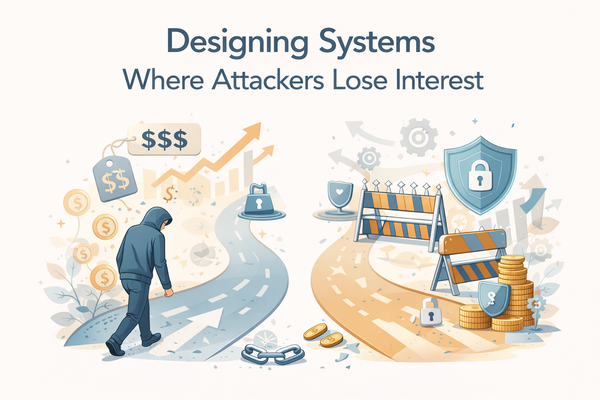
Security improves when systems change incentives, not when they add controls. This essay explores how to design environments where rational attackers disengage because intrusion is no longer economically worthwhile.
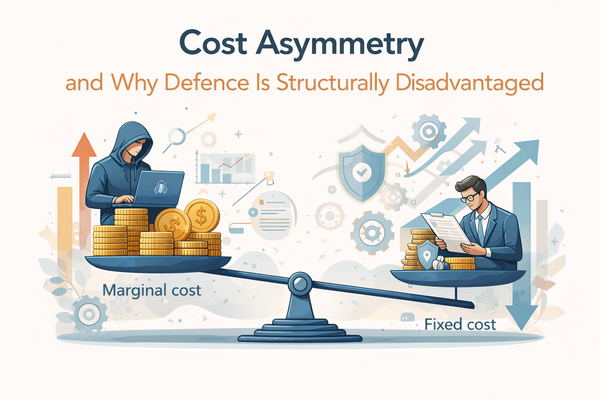
Security fails not because defenders are careless, but because attack and defence operate under radically different cost structures. This essay examines cost asymmetry as the core reason why defence remains structurally disadvantaged.
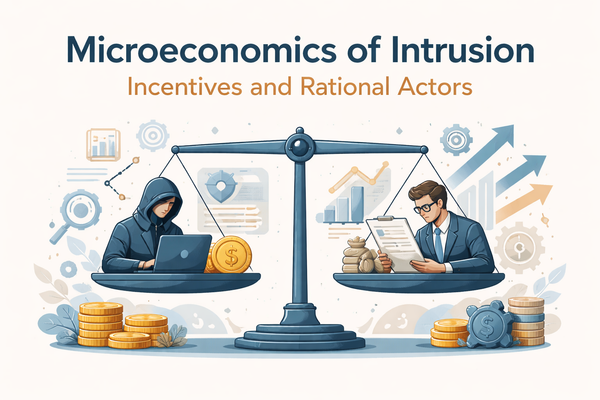
Intrusion is not an anomaly but an economic outcome. This essay reframes attackers and defenders as rational actors and explains why insecurity persists even when systems are competently designed and managed.
I examine how technology shapes power, risk, and responsibility, and how systems can be designed to remain coherent, accountable, and humane under scale and uncertainty.
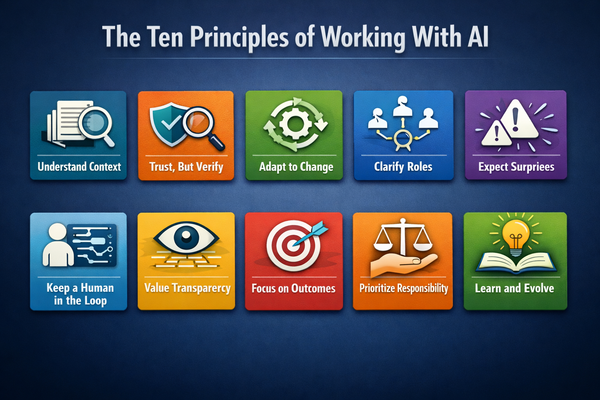
AI has shifted from a tool we pick up to an environment we work inside. This article introduces ten practical principles that clarify how these systems behave, where responsibility remains human, and how to stay oriented as scale, speed, and confidence outpace judgment.
Proof alone does not create trust. This essay explores why interpretation, context, and the responsibility of the observer determine whether proof clarifies reality or silently undermines integrity in complex systems.
National cyber risk is no longer a security issue but a macroeconomic exposure. This blueprint maps how digital fragility propagates into financial, physical, and institutional systems, and why markets and states consistently underprice systemic cyber risk.
Fragile systems persist because their costs are hidden. This essay examines how silent technical debt becomes an economic liability, why fragility is rational in the short term, and how deferred risk quietly erodes adaptability and trust.
Anonymity is not concealment but structural protection. This essay examines the economic and ethical cost of exposure, how visibility concentrates power, and why systems that erase anonymity quietly erode agency, trust, and the possibility of change.
The onramp into technology is no longer forgiving. Junior engineers arrive more capable than ever, yet face fewer openings, thinner support, and higher expectations. This essay examines how the system changed, why potential is being wasted, and how to remain in motion inside a hostile structure.
Intervention in vulnerable systems is never neutral. This essay examines when action protects, when it distorts, and why ethical intervention requires restraint, transparency, and responsibility beyond the moment of urgency.
Digital identities are no longer static. Under pressure, users, systems, and organisations adapt, fragment, and evolve. This essay explores how identity becomes fluid under constraint, and why understanding that evolution is essential for trust and accountability.
Security improves when systems change incentives, not when they add controls. This essay explores how to design environments where rational attackers disengage because intrusion is no longer economically worthwhile.
Security fails not because defenders are careless, but because attack and defence operate under radically different cost structures. This essay examines cost asymmetry as the core reason why defence remains structurally disadvantaged.
Intrusion is not an anomaly but an economic outcome. This essay reframes attackers and defenders as rational actors and explains why insecurity persists even when systems are competently designed and managed.
An envelope arrives just before Christmas, correctly addressed, incorrectly named. For a short time, it remains where it does not belong, asking nothing, changing something.