A Christmas Story
An envelope arrives just before Christmas, correctly addressed, incorrectly named. For a short time, it remains where it does not belong, asking nothing, changing something.
The Envelope with the Wrong Name
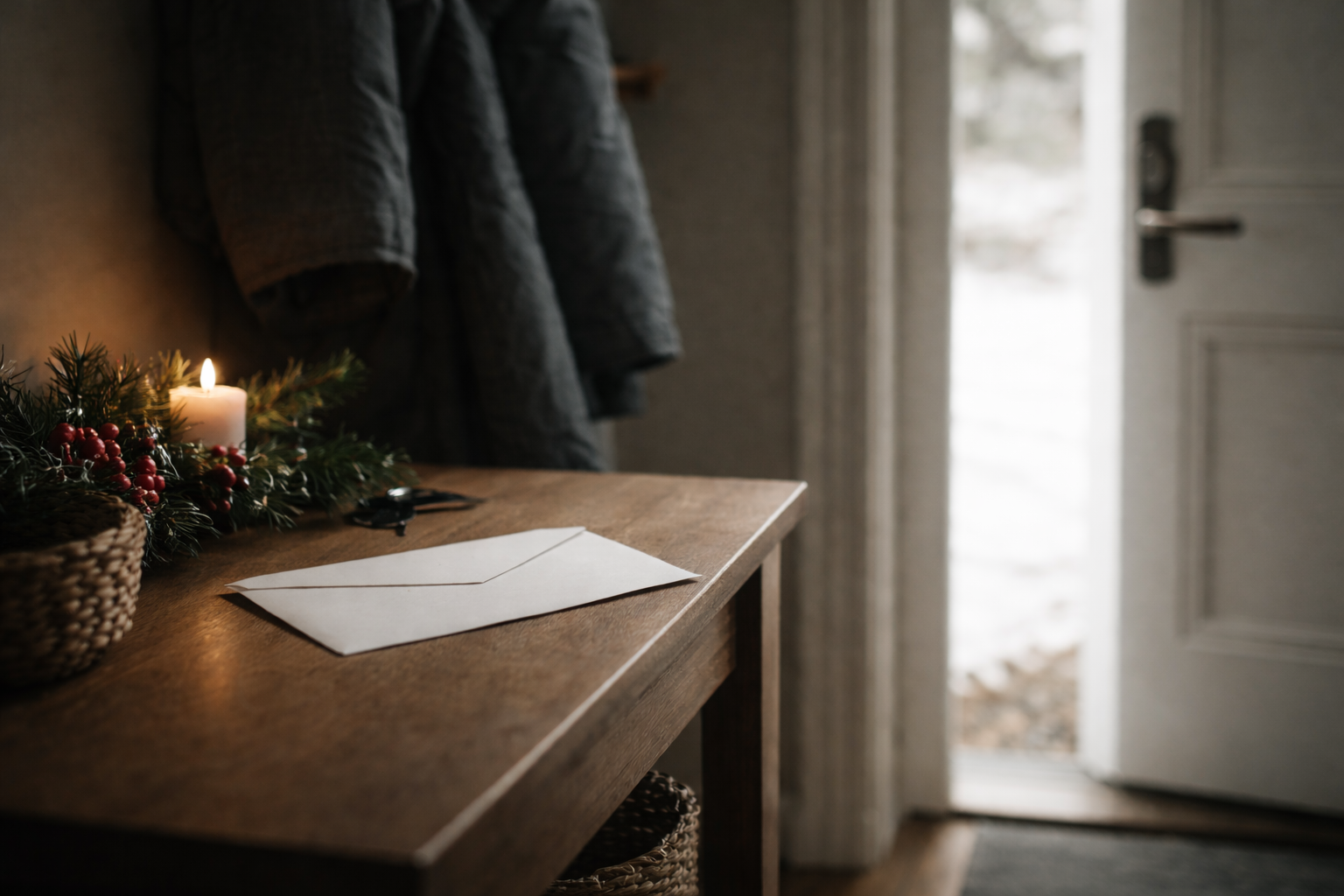
The envelope arrived on the morning of the twenty-third of December, slipped through the letterbox without ceremony, landing on the mat with the quiet confidence of something that believed it belonged there. It was white, heavier than most, the kind of paper that suggested formality rather than care.
The surname was his. The given name was not.
He stood in the hallway holding it, coat still on, keys in hand, reading the wrong name again and again, as if repetition might correct it. Outside, someone dragged a suitcase across the pavement. A car door closed. December had that quality. Movement everywhere, intention diluted by urgency.
He placed the envelope on the small table by the stairs and did not open it.
The house was quiet in the way houses become quiet when someone has recently left. His partner had gone earlier to visit her parents, promising to be back late in the evening with leftovers and vague stories. He had taken the day off, not because there was nothing to do, but because there was nothing he wanted to do urgently. It was the rare luxury of time without obligation, or so he had thought until the envelope arrived.
He made coffee slowly, watching the water darken in the glass pot. The envelope sat where he had left it, visible from the kitchen doorway, quietly rearranging his morning. He pretended not to notice.
After the coffee was finished, he returned to the envelope.
It was from a bank he did not use.
The logo was familiar enough. The language, visible through the thin paper when held to the light, was formal and reassuring. Words like confirmation, activity, review. The tone suggested normality, the absence of alarm.
That, more than anything, made him uneasy.
He opened it carefully, sliding his thumb beneath the flap, as if doing so too quickly might confirm something he preferred to leave undefined.
The letter addressed him as someone else. Same surname. Same address. Different first name, one he did not recognise, written with the confidence of a system that had never doubted itself. The name could have belonged to someone who had lived here before him, or someone who had never lived here at all.
It thanked him for opening an account.
He read it twice, slowly, then a third time faster, looking for clarification that did not come. There was a reference number, a partial account identifier obscured by asterisks, and a phone number printed at the bottom, surrounded by seasonal goodwill and polite assurance.
No threats. No demands. No sense of urgency.
He placed the letter back on the table and sat down on the bottom stair.
Identity theft is usually described as an intrusion. A violation. In practice, it often begins as something quieter: a misunderstanding that has not yet been corrected. A name in the wrong place. A process that accepts coherence where it should require proof. An error of alignment, invisible until it produces consequences.
He thought briefly of ignoring it. The day was cold, the roads busy, and nothing had yet happened to him directly. He could leave it for after the holidays. He could let it become a problem later, perhaps smaller, perhaps larger, but not one he had to confront today.
Instead, he called the number.
The automated system asked him to select from options that did not quite match his situation. He was told his call was important, then held in a queue that existed outside of normal time. The music was classical, simplified, stripped of whatever had once made it memorable. He walked to the window and watched two women across the street embrace on a doorstep, one holding a bottle of wine, both laughing at something he could not hear.
After seven minutes, a woman answered. Her voice was neutral, practiced, efficient in a way that suggested she had already had this conversation many times today.
She asked him to confirm his identity.
He told her he could not.
There was a pause, barely perceptible.
He explained the situation. The wrong name. The right address. The letter he had not requested. He was careful with his words, avoiding accusation. He did not yet know whether anything malicious had occurred. Only that something had aligned incorrectly.
She asked for details. He provided what he could. She asked questions that assumed the account existed, and he answered with care, correcting gently, refusing to confirm what was not his.
After several minutes, she thanked him and placed him on hold again.
When she returned, her tone had shifted. Still professional, but more precise, as if the conversation had moved from a script to a checklist.
She confirmed that an account had been opened online three weeks earlier. That the address matched. That the date of birth did not. That the email address was not his. That no transactions had yet occurred.
She used the phrase "potential identity misattribution," which sounded less alarming than it was.
She assured him the account would be frozen pending review. She asked whether he had recently shared identification documents online, perhaps for travel or employment. He said he had not, though even as he said it, he wondered if that was entirely true. How many forms had he filled in over the years? How many times had he uploaded a scan of his passport, trusting the system receiving it would keep it safe?
She asked whether anyone else had access to his mail. He hesitated. Then said no.
They ended the call with mutual politeness and no sense of closure.
The rest of the day passed quietly, though the quiet had a different texture now. He wrapped a few gifts, more out of habit than necessity. He cooked something simple and ate standing up, watching the light fade through the window. By four o'clock the streetlights had come on. Cars arrived, left, arrived again.
Late in the afternoon, as the last light was fading, he heard the letterbox clatter again.
Another envelope.
This one was addressed correctly.
It was from the same bank.
The language was similar, but the tone was different. More careful. More specific. It acknowledged an error. It thanked him for bringing it to their attention. It confirmed that the account had been closed before activation. It apologised for any inconvenience.
It also suggested, politely but unmistakably, that he review his personal security practices.
There it was. The quiet lesson, embedded where advice often hides, framed as concern rather than instruction. He had done nothing wrong, and yet the letter implied that he might do better. That the fragile routes by which identity travels were ultimately his responsibility to protect.
He did not feel relieved so much as unsettled. The resolution had come too quickly. No loss, no damage, no visible consequence. Only the knowledge that something had almost happened, and that its closing did not make other doors impossible to open.
That evening, his partner returned. He heard her key in the lock, then the particular shuffle of someone removing boots while holding too many things. She appeared in the kitchen doorway, cold and cheerful, carrying containers of food.
He told her about the letters while reheating soup. She listened, leaning against the counter, asking practical questions. Had he checked his credit report? Had he called his own bank? She was good at this, at reducing anxiety to action.
"So nothing happened," she said finally.
"Not this time," he replied.
She looked at him for a moment, as if measuring the distance between what he had said and what he meant. Then nodded and reached for a bowl.
They ate together at the small table by the window. Outside, lights had appeared in windows up and down the street. Uneven and temporary. Decorations that would be gone in a week, leaving no trace except perhaps a nail hole or a memory of effort.
Later, after she had gone to bed, he sat at his desk and did something he had postponed for years.
He reviewed his online accounts, one by one. He made a list first, surprised by how long it became. Banks, utilities, shopping sites, old email addresses, forums he had joined and forgotten. He changed passwords methodically. He enabled verification features he had once dismissed as inconvenient. He removed services he no longer used, clicking through confirmation screens that asked if he was sure.
It took time. It was not satisfying. It felt like maintenance.
At some point he stopped and looked at the screen, aware that none of this guaranteed safety. Only reduction of exposure. Only a narrowing of the surface.
The danger, he thought, lies not in drama but in silence.
On Christmas morning, he woke early, before the light. The house was quiet again, but differently so. Not empty. Resting.
He made coffee and stood by the window, watching the street emerge from darkness. Across the road, a man appeared carrying a Christmas tree that was too large for the doorway. There was a brief struggle, a moment of comic determination, and then success. The tree disappeared around the corner, shedding needles.
His phone buzzed. A message from the bank. The case had been closed. No further action required.
He deleted the message. Then paused. Then archived it instead.
Some records should not be erased entirely. Not out of fear, but out of awareness.
Later that day, as they prepared to leave for lunch with friends, he checked the mail once more. Nothing new. Just flyers, advertisements, seasonal noise.
As they locked the door and stepped into the cold, he felt a small, unremarkable sense of completion. Not victory. Not relief. Simply alignment restored.
His partner took his hand as they walked toward the car. Her fingers were cold. He squeezed them once.
The story would not be told loudly. There was no cautionary speech over lunch, no moral delivered between courses. Only a slight adjustment in how he understood the systems he moved through daily, and how easily they could mistake him for someone else.
That, he thought, was lesson enough.
The holidays passed. They watched films they had seen before. They took walks that ended in pubs. They made plans for the new year that might not survive January.
And then January arrived, with its usual insistence on normality.
The envelope was forgotten. Then remembered, occasionally, like a near miss on a familiar road.
Nothing more happened.
Which was, in its own quiet way, the happiest ending possible.