Principle 2: Verification Is Not Optional
AI systems produce outputs that read as if created by someone who knows what they're talking about. The grammar is correct, the structure logical, the confidence unwavering. This fluency creates a problem: the surface features of credibility are present even when the underlying substance is wrong.
What this principle governs and why it matters
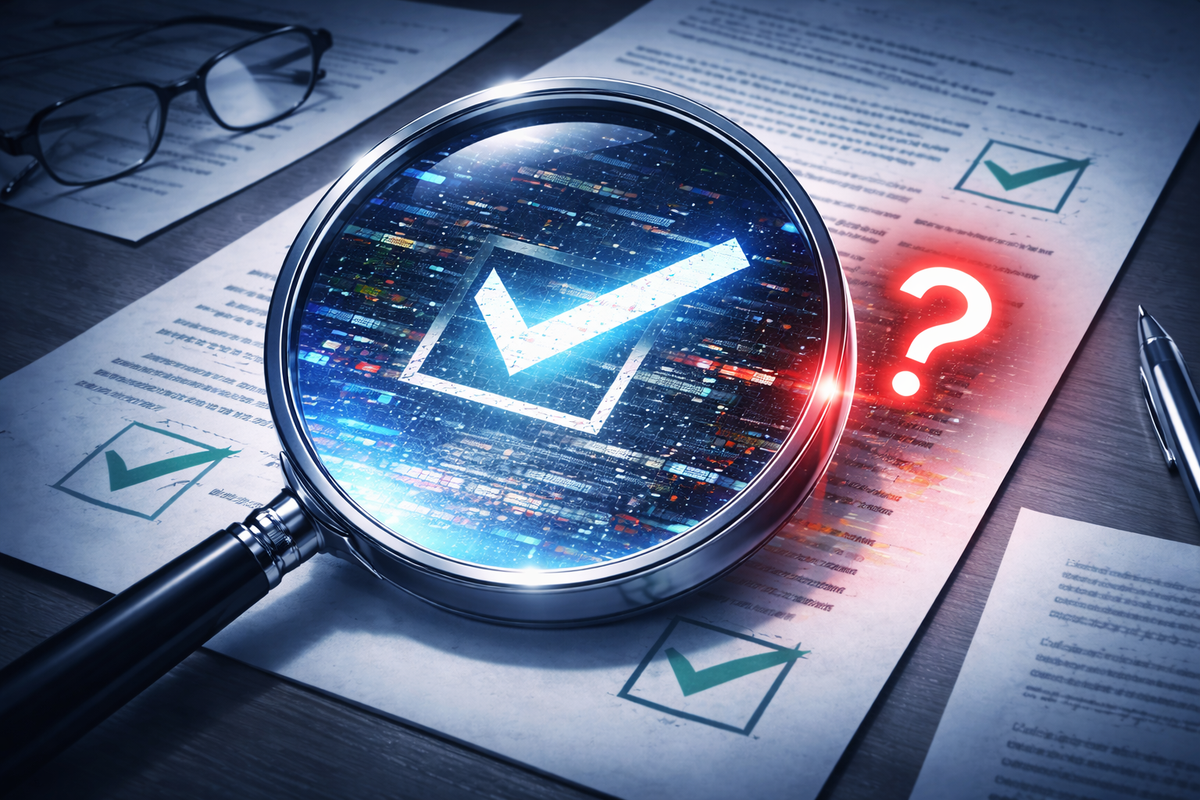
The most seductive quality of modern AI systems is their fluency. They produce outputs that read as if they were created by someone who knows what they're talking about. The grammar is correct. The structure is logical. The confidence is unwavering. This fluency creates a problem that previous technologies did not pose in quite the same way: the surface features of credibility are present even when the underlying substance is wrong.
This principle addresses the gap between plausibility and accuracy—and why that gap must be closed by human verification rather than assumed away by trust in the system. It governs every interaction where AI output will be relied upon, acted upon, or passed along to others as if it were checked. And it matters because the consequences of unverified AI output do not announce themselves in advance. They compound silently until they become visible as failure.
Verification is often treated as a quality control step, something that happens at the end of a process if there's time, a box to check before shipping. This principle asserts something stronger: that verification is not a final step but a structural requirement, built into the nature of how these systems work. To use AI output without verification is not to skip a step but to misunderstand what you're holding.
The footnote that wasn't there
A policy researcher at a think tank is preparing a brief on regulatory approaches to emerging technology. The deadline is tight, the scope is broad, and the material is dense. She decides to use an AI assistant to help with the initial literature review—not to write the brief, but to surface relevant sources, summarize key arguments, and identify patterns across a body of work she doesn't have time to read in full.
The system performs impressively. It produces summaries of academic papers, identifies points of consensus and disagreement, and suggests a framework for organizing the analysis. The output is well-structured and clearly written. It includes citations—author names, publication titles, years, even page numbers. The researcher incorporates several of these into her draft, checking a few against her own knowledge of the field. They seem right. The system appears to understand the literature.
The brief goes through internal review. A senior colleague, reading closely, tries to pull up one of the cited sources—a paper that makes a claim central to the argument. The paper doesn't exist. The author is real, the journal is real, but no such article was ever published. A second citation turns out to be a plausible-sounding hybrid of two different papers, combining an author from one with a title vaguely resembling another. A third cites a report from an organization that does exist, using language that sounds like their work, but the specific report cannot be found.
The researcher is mortified. She had checked some of the citations, and those had been accurate. She had assumed the others would be too—that the system's consistency meant reliability, that fluency implied grounding. The brief is pulled. The deadline is missed. The organization's credibility with the commissioning body takes a hit that will take time to repair.
The system did not malfunction. It performed exactly as designed: generating plausible, well-structured, contextually appropriate text. The citations were not lies in any intentional sense. They were statistically reasonable completions—sequences of words that fit the pattern of what citations in such documents typically look like. The system has no mechanism for checking whether a citation refers to something real, because it has no access to the world beyond its training data and no concept of reference in the way humans understand it. It produces text that resembles verified information without performing verification.
The failure was not that the AI made things up. The failure was that the plausibility of the output obscured the absence of grounding, and that obscuring was sufficient to bypass the verification that should have caught it.
The principle, unpacked
AI systems generate plausible outputs without grounding guarantees. Human verification remains mandatory, not as a preference or a best practice, but as a structural necessity built into the nature of the technology.
This principle is easy to nod along with and difficult to actually honor. Everyone who has worked with generative AI knows, in some abstract sense, that it can produce errors. The problem is that this knowledge tends to fade in the presence of fluent output. The more competent the system appears, the more verification feels redundant. And so verification becomes the thing that gets compressed when time is short, skipped when confidence is high, treated as optional precisely when it matters most.
Understanding why verification is non-optional requires understanding what these systems actually do. Large language models work by predicting what comes next in a sequence, generating responses by sampling from probability distributions shaped by their training data. This process is remarkably powerful, but it means that the system's outputs are not grounded in the way human statements typically are. When a knowledgeable person makes a claim, that claim is usually connected to something—to memory of a source, to direct observation, to a chain of reasoning they could reconstruct if asked.
AI-generated claims don't work this way. They are produced because they are probable, not because they are verified against external reality. The system doesn't check whether a citation exists before generating it. It doesn't confirm that a statistic is accurate. It doesn't know, in any meaningful sense, whether what it's saying is true. It knows only that what it's saying is the kind of thing that tends to appear in contexts like this one.
This is what makes verification non-optional: not that the system makes frequent errors, but that it provides no internal indication of when it is erring. A sentence the model is confident about looks exactly like one it's essentially guessing at. A fabricated citation has the same formatting as a real one. The surface provides no reliable signal about the grounding.
The more dangerous errors are different. They are plausible enough to pass casual inspection—anachronisms, logical contradictions, claims that conflict with well-known facts. Those can be caught by anyone paying attention. The dangerous errors are the ones plausible enough to pass casual inspection, wrong in ways that only domain expertise would catch. The fabricated citation using a real author's name. The statistic in the right ballpark but off in ways that matter. The legal or medical claim that sounds right to a generalist but would make a specialist wince.
These are the errors that compound. They get incorporated into documents that get shared with others. They inform decisions. They become part of the organizational record, cited in future work, treated as established because no one remembers they were never actually checked.
Verification, in this context, is not about catching occasional mistakes. It's about maintaining a connection between what the system produces and what is actually true. The system generates text; humans must supply the grounding. This is the division of labor that makes AI useful rather than dangerous, and it cannot be renegotiated just because verification takes time.
Organizations that use AI without building in verification are not saving time. They are borrowing credibility from their future selves, accumulating a debt of unverified claims that will eventually come due.
The question that remains
There is a practical tension at the heart of this principle that anyone using AI at scale must eventually confront.
The reason people turn to AI in the first place is often that they don't have time to do everything themselves. The researcher uses the system for literature review because she can't read every paper. The analyst uses it for data synthesis because the volume exceeds what manual processing can handle. If verification requires checking everything the AI produces against primary sources, and if that checking takes as long as doing the original work, then what exactly has been gained?
This tension is real, and pretending it doesn't exist serves no one. But resolving it requires being honest about what AI actually provides.
What AI provides is not finished work. It provides material—drafts, summaries, structures, suggestions—that can accelerate the process of producing finished work. The acceleration is real, but it's front-loaded. The system gets you to a draft faster than you could get there yourself. What it cannot do is take you from draft to verified output. That leg of the journey still requires human attention, and the time it takes is not eliminated but shifted.
The efficiency gains are genuine when the task is structured correctly. Using AI to generate a first draft that you then revise and check is faster than writing from scratch. Using AI to surface potential sources that you then verify is faster than starting a literature review with no leads. The gains come from the acceleration of the early stages, not from the elimination of the later ones.
What doesn't work—what this principle rules out—is using AI output as if it were already verified, treating the draft as the final product. That's not efficiency; it's risk transfer. The time you save is paid for by someone else: the colleague who relies on your unverified claim, the customer who acts on inaccurate information, the organization whose credibility absorbs the impact when the error surfaces.
There's also a question of calibration. Not everything needs to be verified with equal rigor. Internal brainstorming has different stakes than external publication. Part of using AI well is developing judgment about where verification is critical and where a lighter touch is acceptable. But this flexibility has limits. The places where people are most tempted to skip verification—when time is short, when the output looks convincing, when the pressure to ship is high—are often precisely the places where consequences of error are most severe.
The question that remains is not whether to verify, but how to build verification into processes that are under pressure to go faster. How to create checkpoints that actually function rather than becoming rituals. How to ensure that the people doing the checking have the expertise to catch the errors that matter, and the authority to slow things down when something doesn't look right.
Fluency is not accuracy, and plausibility is not the same thing as truth.. The system will not tell you when it's wrong.
Someone has to check. The question is whether you've made that possible or merely hoped it would happen.