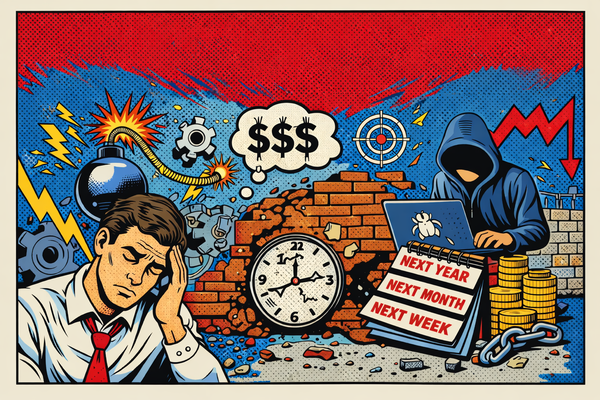
Signal, Noise, and the Burden of Interpretation in High Risk Decision Making
High risk decisions fail not from lack of data, but from misinterpretation. This essay explores how signal, noise, and institutional bias shape judgment, and why interpretation itself becomes the hidden burden in consequential systems.

High risk decision making rarely fails because information is unavailable. It fails because information is abundant, unevenly distributed, and unevenly interpreted. In modern systems, whether technical, institutional, or geopolitical, decision makers are surrounded by signals that compete for attention, overlap in meaning, and contradict one another in subtle ways. The central challenge is no longer access to data, but the ability to distinguish what matters from what merely appears urgent, and to act under conditions where interpretation itself carries moral and operational weight.
This essay explores the tension between signal and noise, not as an abstract analytical problem, but as a lived condition within high risk environments. It argues that interpretation is not a neutral act. Every choice to elevate one signal over another reflects assumptions, incentives, and cognitive limits. In systems where consequences are irreversible, interpretation becomes a burden rather than a convenience, and the quality of decisions depends less on computational power than on the discipline with which humans construct meaning from uncertainty.
When Information Becomes a Liability
Information systems were designed to reduce uncertainty, yet in practice they often amplify it. Dashboards accumulate metrics. Alerts multiply. Reports arrive faster than they can be read. In high risk environments, this abundance creates a paradox. The more signals available, the harder it becomes to identify which ones deserve trust.
Noise is not simply irrelevant data. It is data that obscures judgment by demanding attention without offering clarity. In operational contexts, noise frequently masquerades as signal. A familiar metric may continue to update even after it has lost its connection to reality. A legacy alert may fire reliably while failing to indicate meaningful risk. A trend line may remain stable while underlying conditions shift.
When decision makers treat volume as evidence of insight, they confuse activity with understanding. The result is not ignorance, but misdirected confidence.
The Interpretive Layer of Risk
Every system that produces signals relies on an interpretive layer, whether explicit or implicit. Humans decide thresholds. Humans decide what constitutes abnormal behaviour. Humans decide which anomalies justify intervention and which ones can be ignored. These decisions embed values into the system, often without conscious reflection.
In high risk settings, interpretation cannot be delegated entirely to automation. Automated systems excel at pattern detection but struggle with contextual meaning. They identify correlations without understanding consequence. They escalate based on predefined rules rather than situational judgment. As a result, human interpretation remains indispensable, yet increasingly strained.
The burden of interpretation grows heavier as systems scale. A single operator may be responsible for interpreting signals from infrastructures spanning continents, institutions, or populations. Under these conditions, interpretation becomes an act of compression. Complexity must be reduced to enable action, and reduction always carries the risk of distortion.
Cognitive Load and the Cost of Attention
Attention is finite. In high risk environments, it is also expensive. Every signal that demands attention competes with others for limited cognitive resources. When systems generate excessive alerts, they erode the very capacity required to respond effectively.
This phenomenon is not hypothetical. It has been observed repeatedly in domains ranging from aviation to healthcare to cybersecurity. Alarm fatigue does not arise because operators are negligent. It arises because human cognition is bounded. When everything is framed as urgent, nothing is processed deeply.
Noise therefore imposes a hidden cost. It degrades interpretive quality by exhausting attention. Over time, decision makers learn to filter aggressively, sometimes dismissing weak signals that later prove decisive. The tragedy is not that signals were absent, but that they were indistinguishable from noise at the moment they mattered.
Signal Does Not Speak for Itself
A persistent myth in technical culture is that signal is self evident. This belief assumes that meaningful information will naturally stand out if only the right data is collected. In reality, signal emerges only through interpretation.
A signal acquires meaning through context, history, and consequence. A deviation may be insignificant in one situation and catastrophic in another. A delay may be tolerable under normal load and fatal under peak conditions. Without contextual framing, raw data remains ambiguous.
High risk decision making therefore depends on narrative coherence. Decision makers must construct a plausible explanation of what the signals represent and why they matter. This narrative is always provisional. It can be revised, challenged, or overturned. Yet without it, action becomes impossible.
The danger lies not in constructing narratives, but in mistaking them for truth rather than hypothesis.
Institutional Incentives and Selective Interpretation
Interpretation does not occur in a vacuum. Institutions shape which signals are valued and which ones are ignored. Performance metrics influence attention. Reporting structures influence escalation. Cultural norms influence whether uncertainty is disclosed or suppressed.
In many organisations, signals that threaten existing plans are interpreted sceptically, while signals that confirm expectations are accepted readily. This asymmetry is rarely intentional. It reflects incentive structures that reward stability, continuity, and predictable outcomes.
High risk failures often reveal this bias in retrospect. Warning signs were present, but they conflicted with dominant narratives. Decision makers did not lack information. They lacked institutional permission to reinterpret it.
The burden of interpretation thus extends beyond individuals. It becomes a collective responsibility shaped by governance, leadership, and organisational memory.
Noise as a Structural Phenomenon
Noise is often treated as an operational nuisance, something to be filtered out through better tooling or smarter algorithms. Yet noise is frequently structural. It arises from system design choices that prioritise visibility over meaning.
When systems are instrumented without a clear theory of relevance, they generate data that satisfies reporting requirements rather than decision needs. When accountability is distributed, signals proliferate to ensure coverage, even if coherence is lost. When risk is transferred rather than resolved, noise becomes a proxy for diligence.
Reducing noise therefore requires more than technical optimisation. It requires architectural restraint. Systems must be designed with an explicit understanding of how signals will be interpreted under stress, not merely how they will be collected.
The Ethics of Interpretation Under Uncertainty
In high risk contexts, interpretation carries ethical weight. Decisions based on misinterpreted signals can harm individuals, destabilise institutions, or escalate conflict. The responsibility to interpret carefully is therefore not merely operational. It is moral.
Ethical interpretation involves acknowledging uncertainty rather than concealing it. It involves resisting the temptation to overstate confidence in ambiguous signals. It involves creating space for dissenting interpretations, especially when consensus forms too quickly.
Silence can be ethical when it reflects humility. It becomes unethical when it conceals doubt in order to preserve authority or avoid accountability. The difference lies in intent and transparency.
Learning to Design for Interpretability
Systems that support high risk decision making must prioritise interpretability over raw throughput. This includes:
- reducing alert volume to preserve attention
- exposing uncertainty rather than smoothing it away
- providing contextual history alongside real time data
- enabling comparison rather than isolated evaluation
- supporting human judgment rather than replacing it
These principles recognise that interpretation is not a failure of automation, but its necessary complement. A system that overwhelms its users with undifferentiated signals undermines its own purpose.
The Burden Cannot Be Eliminated
No system can remove the burden of interpretation entirely. Uncertainty is intrinsic to high risk environments. Ambiguity cannot be engineered away. What can be improved is the alignment between signal production and human capacity.
Decision makers will always operate under incomplete information. The goal is not perfect clarity, but proportional understanding. Signal must be sufficient to justify action without creating false certainty. Noise must be constrained to preserve judgment.
The maturity of a system can be measured by how it treats interpretation. Systems that respect interpretation treat humans as thinkers rather than executors. Systems that disregard it reduce humans to filters, and filters eventually fail.
Summary
Signal and noise are not opposites. They are products of interpretation. In high risk decision making, the challenge is not to eliminate noise entirely, but to design systems and institutions that acknowledge the burden of interpretation and support it with discipline, humility, and structural care.
When decisions matter most, the quality of interpretation determines outcomes more than the quantity of data. The future of high risk systems depends not on seeing more, but on understanding better.
Sources
Daniel Kahneman. Thinking, Fast and Slow. Farrar, Straus and Giroux. https://us.macmillan.com
Herbert A. Simon. Models of Bounded Rationality. MIT Press. https://mitpress.mit.edu
Nassim Nicholas Taleb. The Black Swan. Random House. https://www.penguinrandomhouse.com
NIST. Risk Management Framework. National Institute of Standards and Technology. https://csrc.nist.gov
MIT Human Systems Laboratory. Decision Making Under Uncertainty. https://humansystems.mit.edu
UK National Audit Office. Information Overload and Decision Risk. https://www.nao.org.uk