The Reality Hunger
In a world saturated with synthetic media and endless simulation, unmediated reality is becoming scarce. As representation expands, presence, risk, texture, and truth grow more valuable. The future may not belong to better simulations, but to those who seek the real.
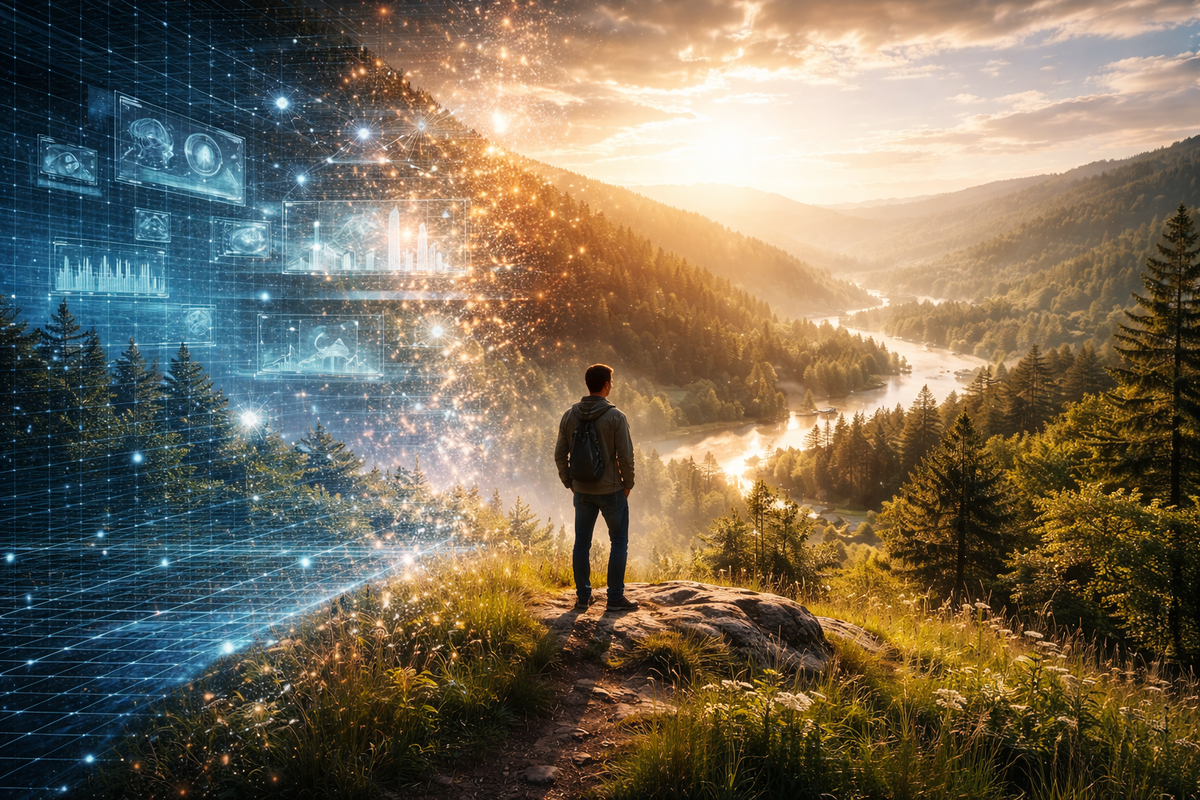
In an age of synthetic everything, the most radical act may be encountering the world as it actually is
There is a moment, and if you've spent too long in front of screens you already know the one I mean, when the mediated world begins to feel thin. The images keep coming. The content keeps flowing. The algorithms keep serving up what they predict you want. And yet something is missing. I keep circling around what that something is without quite nailing it. The feed cannot provide it. The simulation cannot touch it. Maybe no sentence can.
We are living through an unprecedented explosion of synthetic media. AI-generated images flood social platforms. Recommendation systems curate our cultural diet. Deepfakes blur whatever line used to exist between documentation and fabrication. Video game worlds achieve photorealism. Virtual influencers amass real followers. The tools to generate convincing synthetic content (images, audio, video, text) are now accessible to anyone with a laptop and a connection. We have never been more surrounded by representations of reality.
Whether we've ever been further from the thing itself. I think so, but I'm probably overstating it. Or maybe not.
What I want to explore is a provocation more than an argument: that reality itself is about to become the next cultural frontier. That a generation raised on digital illusions is beginning to crave something far more radical than the next platform or the next filter. They're beginning to crave what's actually there.
The synthetic saturation
To understand why reality might become countercultural, you have to understand just how synthetic our environment has become. Though "understand" might be the wrong word. It's more like noticing the water you're swimming in.
The average person now encounters more images in a single day than someone living a century ago would have seen in a lifetime. That statistic probably isn't precise (I've seen versions of it that vary wildly) but the direction is inarguable. Most of these images aren't photographs of things that exist. They are composites, manipulations, generations. Optimized for engagement, filtered for aesthetic consistency, curated by algorithms that learn what makes us pause, click, linger. The visual environment we inhabit is largely artificial: constructed for effect rather than captured from reality. Not false. Constructed. There's a difference, though some days I'm not sure how much of one.
This goes beyond the visual. The music we hear is quantized, autotuned, algorithmically distributed based on predicted preference. The news we consume is selected by systems designed to maximize attention. The social interactions we have online are mediated by platforms whose architectures shape what we say and how we say it. Even our sense of what other people think and feel, which used to come from reading a room, from body language and silence and someone's eyes, gets filtered through systems that amplify certain signals and suppress others.
Almost everything we encounter has been processed, optimized, intermediated. The raw encounter with something not designed for consumption has become genuinely rare. That sentence sounds like something from a manifesto. I don't entirely trust it. But I don't know how to make it less true.
Generative AI accelerates this. When AI can produce photorealistic images of scenes that never existed, convincing audio of words never spoken, video of events that never happened, the already thinner boundary between real and synthetic dissolves further. We enter a world where any piece of media might be generated. Where visual evidence proves nothing. Where "is this real?" becomes unanswerable through inspection alone.
The fatigue sets in
Among younger generations, those who have never known a world without smartphones and social media, something interesting is happening. The digital natives are getting tired.
The signs are scattered but consistent. Film photography over digital, valued not for image quality but for the constraints: you can't see the result immediately, can't take infinite shots. Vinyl resurgent. Physical books. Handwritten letters, which still surprises me. A movement toward dumbphones that do less. A suspicion of filters that shows up in the popularity of deliberately unpolished content. A hunger for experiences that cannot be captured and shared, that exist only for those present.
Not dominant trends. The synthetic world continues to expand. But at the margins, where culture shifts before the mainstream notices, there is a turning.
I want to be careful here because I can feel myself romanticizing. Not every twenty-two-year-old buying a film camera is making a philosophical statement. Some of them just think it looks cool. Fair enough. But the fatigue is real, and it has several sources. The exhaustion of infinite choice. The emptiness of optimized experience, that specific flatness when everything is designed to engage you and nothing actually moves you. The loneliness of mediated connection: hundreds of online interactions can leave you more isolated than one conversation with someone present in the room. I've felt this. Most people I know have felt this and don't talk about it much.
And something harder to name. A kind of ontological unease from spending too much time in environments that are not quite real. A sense that the synthetic world, however convincing, lacks something essential. Insubstantial. The philosophers would recognize that word. I'm borrowing it because I can't find a better one.
The scarcity of the real
Value emerges from scarcity. What is abundant becomes cheap; what is rare becomes precious. For most of human history, representations were scarce and reality was abundant. Images were expensive to produce. Recordings required significant effort. The default experience was unmediated encounter with the physical world.
We have inverted this relationship. Or it has been inverted for us. Hard to say which.
Representations are now effectively infinite. Anyone can generate endless images, videos, texts. The marginal cost of producing synthetic content approaches zero. Meanwhile, unmediated reality has become scarce. Experiences not designed, curated, optimized, or recorded are increasingly rare. Attention not captured by screens is increasingly unusual. Presence, simple presence in a place with other people without the mediation of devices, almost countercultural.
So authenticity, previously so abundant it was invisible, gains value precisely because it becomes rare. The genuine article, the unfiltered experience, the thing itself rather than a representation of it: these carry a premium they never carried before. Not because they're somehow metaphysically superior. Because they're scarce in a world drowning in simulation.
You can see this already in markets. Experiences outcompete possessions in consumer spending, not because experiences are new but because they resist digitization. Live events command premiums that recordings cannot. Handmade objects sell for multiples of machine-made equivalents, and the reason isn't functional superiority. The marks of human making are legible, and people pay for that legibility.
The same logic may be spreading through culture more broadly. If synthetic media is abundant and reality is scarce, reality becomes the luxury good. The next status symbol may be what you've actually experienced: unmediated, unoptimized, unshared.
Though luxury good is the wrong metaphor. Implies exclusivity, velvet ropes, scarcity manufactured for profit. What I mean is something more like oxygen. Valuable because you suddenly realize you need it.
Reality as rebellion
Every generation defines itself partly through rejection. The children of conformity became hippies. The children of hippies became punks. The children of analog became digital natives.
What do the children of simulation become?
Maybe they become realists. Forget epistemology for a minute. I mean it in the cultural sense. People who orient toward the actual, the physical, the present. People who seek out what cannot be faked because they grew up surrounded by fakery. People for whom the unmediated encounter is not the default but the achievement.
This would represent a genuine cultural shift. For decades, the trajectory has pointed one direction: more mediation, more simulation, more virtuality. The assumption has been that as synthetic experiences improve, they'll increasingly substitute for real ones. Why travel when you can explore virtually? Why meet in person when you can connect online? Why encounter the messy, inconvenient, unoptimized real world when a better version is available on demand?
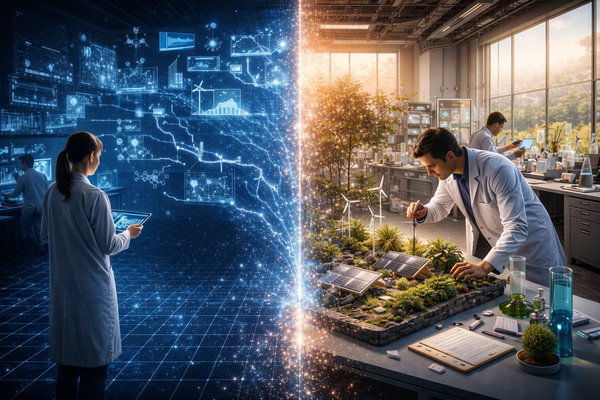
But substitution has limits, and the limits are becoming visible. Simulation accelerates understanding but cannot replace what it models. AI-driven systems test hypotheses faster than physical experiments. Virtual environments train skills more efficiently than real-world practice. Synthetic media communicates ideas more vividly than unfiltered documentation. But at some point the model must be validated against the world. The map must meet the territory.
This works as both warning and invitation. Warning against mistaking the map for the territory. Invitation to recognize what reality alone provides: an irreducible complexity, a resistance to optimization, a refusal to conform to our models. That resistance is the point.
What cannot be simulated
So what does reality offer that simulation cannot?
Start with presence. Being somewhere (actually there, with a body that occupies space and senses that take in unfiltered input) differs from any representation of that experience. I don't mean this mystically. I mean it phenomenologically, though I'm probably using the word loosely. The felt sense of presence involves dimensions screens and speakers cannot capture: peripheral vision, ambient sound, temperature, smell, the subtle awareness of other bodies nearby. Simulations approximate some of these. They cannot replicate the integration of all of them. They especially cannot replicate the knowledge, below the level of thought, in the body itself, that you are actually there.
Texture. Reality has a granularity that representations smooth away. A forest is full of small irregularities, imperfections, variations that exceed what any model captures. A photograph of that forest is not the forest. Walk through the real one and you encounter countless details no designer placed there. No algorithm optimized them. No system anticipated them. This undesigned complexity. I think it's part of what makes reality feel real. That's a circular statement and I'm going to let it stand.
Risk. When you climb an actual mountain, you can actually fall. When you have an actual conversation, you can say something you'll regret for years. When you commit to an actual relationship, you can be hurt in ways you didn't know you were vulnerable to. Simulations appeal precisely because they offer the form of experience without this danger. But the danger gives real experience its weight. Courage in a simulation is rehearsal. Love through a screen is correspondence. I don't want to push this too hard, plenty of meaningful things happen through screens, but there's a floor below which mediation cannot reach.
Truth. Not truth as correspondence to fact, but truth as encounter with what is actually the case, independent of your wishes, expectations, or designs. Reality does not care what you want it to be. The mountain doesn't care if you like it. The ocean isn't optimized for your attention. And this indifference. I want to say it's what makes the encounter meaningful, but that sounds too neat. It's more like relief. After so much content calibrated to your preferences, encountering something that simply is what it is feels like putting down a weight you didn't know you were carrying.
The paradox of power
Here is what I keep returning to: the more powerful simulations become, the more people rediscover the value of what cannot be simulated.
Counterintuitive. You'd expect improving synthetic experiences to increasingly substitute for real ones. And for many purposes they do. Training in simulators replaces some real-environment training. Virtual meetings replace some physical gatherings. AI-generated content replaces some human-created content.
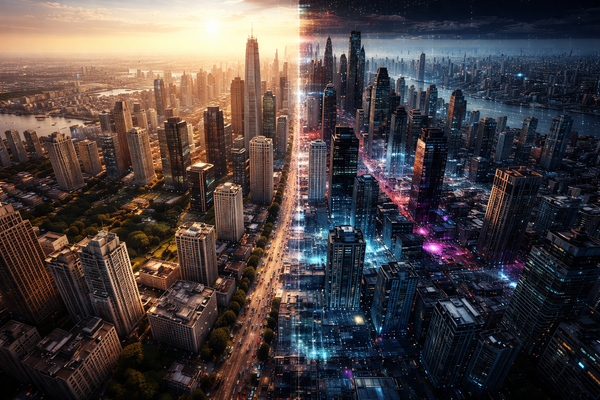
But as simulations become more pervasive, the contrast with reality sharpens. Presence and texture and risk and truth, the things that resist simulation, become more noticeable precisely because everything else is being simulated. Against a background of synthetic everything, the real becomes conspicuous.
Which is why the rebellion, if it comes, will be driven by those who know technology best. The digital natives who grew up inside the simulation feel most acutely what it lacks. They don't romanticize the pre-digital world. They never knew it. But they sense that something is missing. I think this sensing is getting louder.
We can use AI to understand reality faster. Models to test hypotheses more efficiently. Synthetic media to communicate more vividly. But simulation cannot substitute for reality, because reality is what the representations are of. The territory the maps describe. What remains when all the models are turned off.
I've said this already. I keep saying it because I keep needing to hear it.
Reclaiming the real
What would it mean to reclaim reality in a world that keeps trying to simulate it?
Not rejecting technology. That's neither possible nor desirable, and anyway the tools of simulation are also tools of understanding. The person who uses AI to explore possibilities faster and then tests those possibilities against the actual world is engaging reality more effectively.
But reclaiming reality means remembering what technology cannot provide. Seeking out experiences that resist optimization. Encounters that refuse curation. Moments that exist only for those present.
In practical terms, and I'm aware this risks sounding like a wellness blog, but here it is: putting down the phone and looking at what is actually in front of you. Traveling to places rather than viewing images of them. Having conversations without screens between you. Making things with your hands and accepting their imperfections. Being bored sometimes. Sitting with discomfort rather than swiping it away.
Small things. Increasingly radical things. In a world where every moment can be filled with content and every experience enhanced by technology, choosing not to fill and not to enhance becomes a statement. This, here, now, unoptimized. Enough.
The great revolutions of the past two centuries have been technological. Steam power, electricity, computing, networks. Everyone assumes the next one follows the same pattern.
Maybe it won't. Maybe the next revolution is existential: a return to the real. Technology recontextualized, in service of encounter with reality, not in substitution for it. Simulation as a tool for understanding the world, then insistence on meeting the world directly.
Such a revolution would be quiet. Small choices. Turning away from screens. Seeking presence. Valuing what cannot be scaled or copied or optimized. It would spread not through platforms but through example, through people who seem somehow more alive.
The synthetic will keep expanding, it always does, and the question was never whether it would but whether we'd remember what it was expanding over.
But there will be those who remember that the map is not the territory. That the representation is not the real. They will seek out what cannot be simulated, not because it's better, but because something in them, something the algorithms haven't reached yet, still knows the difference.
Somewhere between the last scroll and the next, there is a door you already know how to open, and the only thing on the other side is what has always been there.